Reliability and Bias: A Practical Framework
When evaluating any news source, it helps to consider two separate questions:
Reliability
Does the source report facts accurately? Does it cite evidence, correct errors, and distinguish between news and opinion? Reliable sources invest in verification and accountability.
Bias
Every source has some perspective, but does it present multiple viewpoints fairly? Does it use neutral language, or does it inflame emotions? Understanding bias helps us read critically.
These two dimensions are independent. A source can be highly reliable but lean politically left or right. A source can claim to be neutral but publish misleading information. The goal is to find sources that are both reliable and fair in their presentation.
The Media Bias Chart
One tool for visualizing these dimensions is the Ad Fontes Media Bias Chart, which maps hundreds of news sources along both reliability (vertical axis) and political bias (horizontal axis).
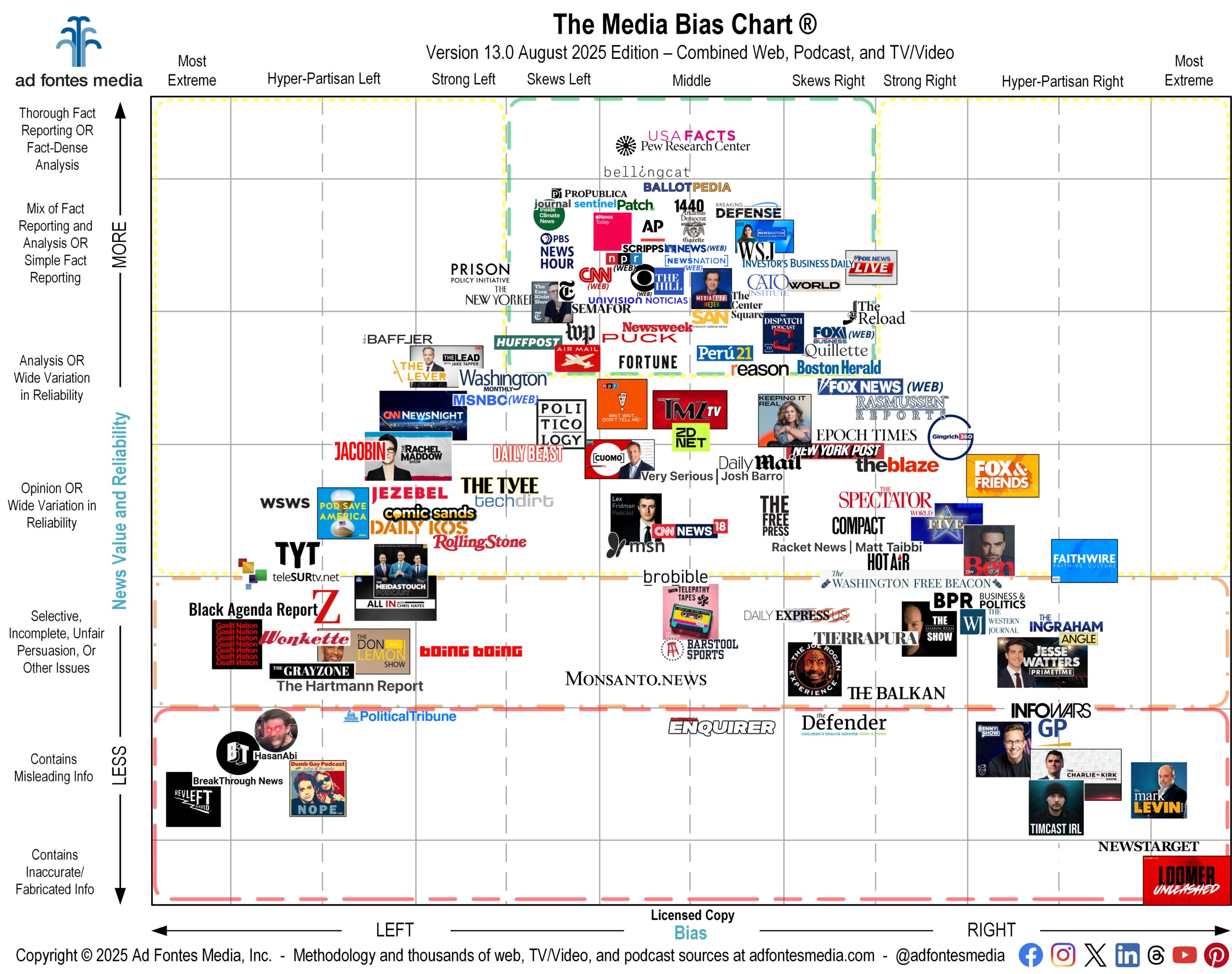
Chart by Ad Fontes Media. Click to explore the interactive version.
The news sources cited in General Conference tend to fall within the high-reliability, low-bias categories on charts like this. The New York Times, Wall Street Journal, and Washington Post are among the most frequently cited secular sources. This pattern suggests that church leaders are modeling the kind of discernment they encourage in others.
How to Read the Chart
- Vertical axis (Reliability): Sources at the top contain original, fact-based reporting. Sources lower down mix more opinion, analysis, or may contain misleading information.
- Horizontal axis (Bias): The center represents minimal political leaning. Left and right indicate progressive or conservative perspectives. The extremes show hyper-partisan content.
- The "green zone": Sources in the upper-middle area tend to be the most reliable and balanced.